Product · Export
Seals only when you say so.
Export is the surface that decides whether the rest of the loop was worth running. Fermito assembles the document in the firm’s house format - header, footer, signature block, distribution list, revision history - and waits. The seal-ready document does not leave Fermito until the engineer explicitly confirms it should.
The export is not a markdown render with the firm's logo on top. It is a real, structured document, assembled programmatically against the firm's template.

What export does
Four properties of a delivery-ready document.
Each one is the difference between a draft a tool produced and a document a firm is willing to put in front of a client.
01 · House format
Header, footer, signature block, distribution - the firm's own.
The export is not a generic template with the firm's logo dropped on top. It is a document assembled in the structure the firm signs reports in - page header, page footer, signature block, distribution list, page numbering - to the level of fidelity a senior reviewer can read without flinching. House format is what makes the export delivery-ready, not just printable.
Programmatic document assembly · per-firm template parameters
02 · Photos in place
Photos embedded in the report, not attached as a separate folder.
Photos captured on the visit are embedded in the export in the order they were referenced, with italic copper captions in the firm's signing voice, page numbering carried through. The engineer does not assemble a photo appendix manually; the document arrives with the appendix already in it.
ImageRun embedded · italic copper captions · footer page numbers carried through
03 · Revision aware
Re-issued reports carry their own revision identity.
When a report is re-issued, the export reflects it. The document title and filename show Rev N, a Revision History section is added to the body explaining what changed, and the prior issue is marked superseded, not deleted. The engineer’s revision chain is preserved in the firm’s file system the same way it would be in a paper archive.
Lifecycle: draft → issued → superseded → closed · revision chain in file metadata
04 · Observations-only export
Compact observation summaries when the full report is not needed.
Some firms send observations-only summaries to general contractors between formal report issuances. Fermito has a dedicated observations export - a compact document with the same header and the observation list, generated in the same loop. The full report stays the formal record; the summary is the operational artifact.
Compact header · observation list only · same firm format
The engineer always signs
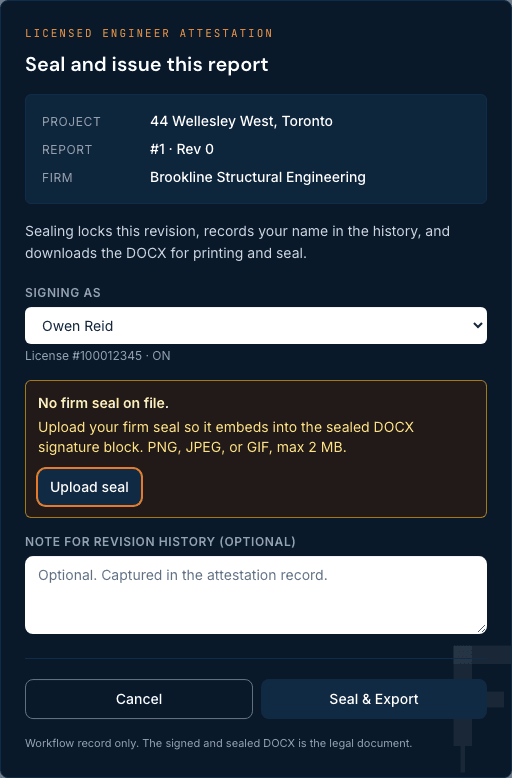
Fermito will not export a sealed document without the engineer’s explicit confirmation.
The attestation gate is a hard product invariant, not a default the engineer can quietly turn off. Fermito assembles the document, holds it at the export surface, and waits. The engineer reads what is about to be sealed and confirms; only then does the seal-ready document leave the system.
The invariant exists at the route level, not just in the UI. There is no auto-seal path, no auto-distribute path, and no API surface that bypasses the attestation step. A second editor cannot seal on behalf of the engineer who drafted; the seal-holder of record signs the document the seal-holder of record reviewed. Fermito stops at the assembled document; the practitioner carries it the rest of the way.
The seal is the practitioner's
Fermito does not seal documents. It assembles them so a practitioner can.
Affixing a Professional Engineer’s seal is regulated under PEO Regulation 941 and is the act that makes a report a sealed engineering document. Fermito does not perform that act. There is no “seal and send” button, no auto-distribute, no path from the export surface to a client’s inbox that bypasses the practitioner.
The document leaves Fermito and enters the firm’s normal sealing workflow - paper or digital, depending on house practice. The engineer reviews the assembled document, applies the seal, and distributes it through whatever channel the firm uses for sealed deliverables. Fermito stops at the document; the practitioner carries it the rest of the way.
Revision identity is carried in the file metadata and the document body so that a sealed document and its successor are linked in the firm’s archive, the way a paper revision would be filed behind its predecessor in a project binder.
Next surface
The export ships. The next site visit begins.
Capture is the first surface a Fermito firm touches each day. Voice, photos, and supporting documents on the phone the engineer already carries.