How it works
How Fermito thinks.
A walk-through of the work Fermito does between a site visit and a sealed draft. Written for the principal who wants to know what the assistant is actually doing under the calm surface.
Seven steps. The intelligence is named in categories, not spec-sheets. The model and the prompts stay where they belong, which is in the product. The point of this page is not to publish the recipe; it is to make the depth legible to a reader who has already pattern-matched too many AI tools to trust the next one on a marketing claim.
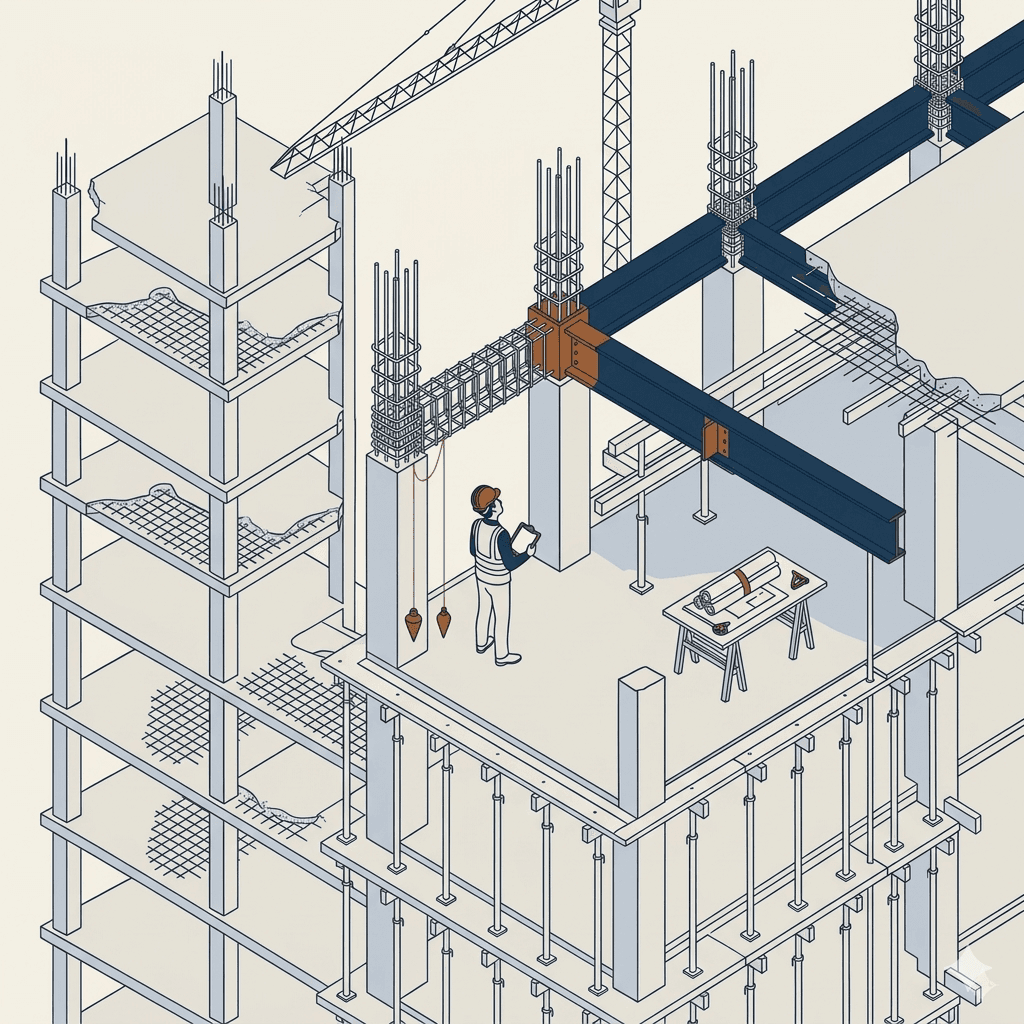
01 · Listens
Voice, photos, and supporting documents arrive as one transcript before drafting begins.
A site visit produces a small archive: a few minutes of dictated voice, a folder of photos, a structural detail PDF a contractor handed over, sometimes a prior report from a year ago that the firm wants the language pulled from. Fermito treats every one of those artifacts as evidence and merges them into a single dated transcript before the drafting step ever runs.
The merge is what matters. A draft assembled from four separate input fields reads like four separate input fields. A draft assembled from a unified record reads like one engineer wrote it after walking the site. Multi-language input is part of the same fusion: an engineer can dictate in Farsi or Mandarin or Hindi while the firm signs in English, and the merge happens upstream of the prose.
The engineer never has to remember which note went into which field. The visit is the unit of work. Fermito reads the visit.
Drafts that read like one author, even when the source notes were captured across three devices and two languages.
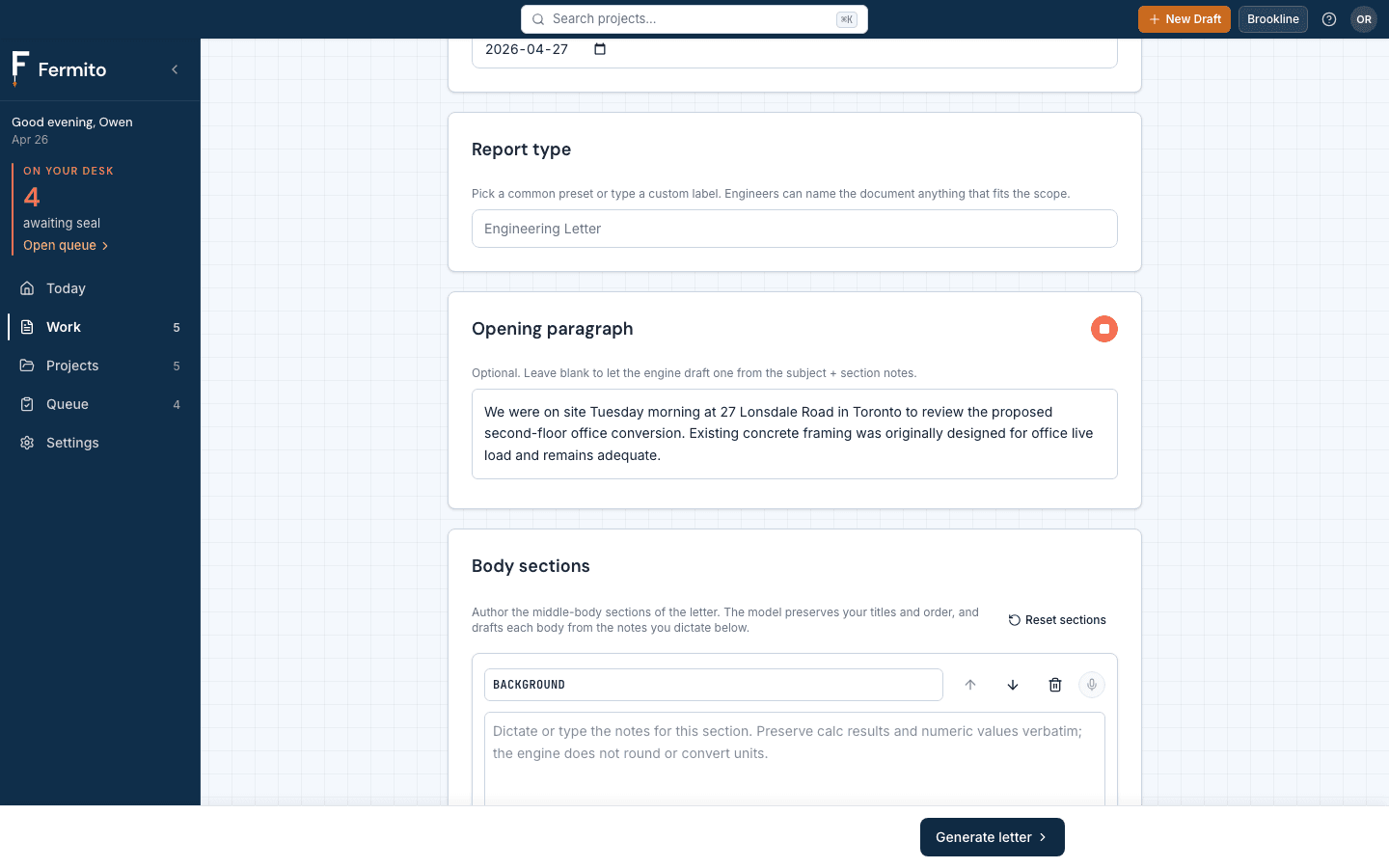
02 · Reads the photos
Vision captioning grounds the draft in what the photos actually show, not just what was said about them.
Every photo from the visit is captioned by a vision pass before the draft is assembled. The caption is provisional and the engineer can rewrite or accept it on the way to seal, but it does one important thing in the meantime: it puts the photo's content into the same evidence pool as the voice notes and the documents.
That is why a Fermito draft will sometimes flag, in plain language, that the engineer's note says concrete and the photo shows steel framing. The drafting step is not just rephrasing what was dictated. It is reading the photos against the dictation and surfacing the disagreement before the engineer ever sees the prose.
The mismatches are not auto-corrected. They are surfaced. The engineer decides which side of the disagreement is right.
The first time a Fermito draft catches a photo-versus-text contradiction, the buyer stops asking whether vision is real.
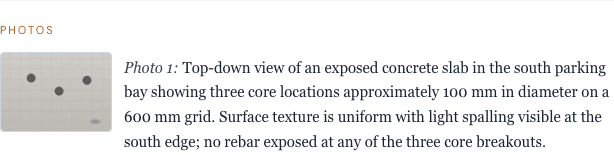
03 · Drafts in your firm's voice
Per-firm template encoding plus a firm-specific phrase library, learned from the firm's own prior letters.
Every firm has a house voice that is encoded across its prior sealed work: section order, standard callouts, the recurring sentences a principal has been sharpening for a decade, the cover and header and footer and signature block and distribution list that make a sealed letter look like the firm's. Fermito ingests that voice and reuses it.
Templates carry the structural beats. A phrase library, learned from the firm's own corpus, carries the recurring language. Together they mean the first draft a firm sees on Fermito reads like the firm wrote it, because in the parts that recur, the firm did. The novel content is the engineer's judgment from this visit; the framing around it is the firm's.
The voice belongs to the firm. Every revision teaches the system a little more of it. Leaving Fermito means leaving months of captured house language behind, which is the price of doing work this specific.
04 · Critiques its own draft
Two-pass generation. Fermito drafts, then re-reads its own draft against a critique pass before the engineer sees it.
The first draft Fermito writes is not the first draft the engineer sees. Once an initial pass is assembled, Fermito re-reads it against a structured critique pack and rewrites the parts that do not hold up. The engineer reviews the second draft, not the first.
What the critique catches is the kind of slack a junior reviewer would catch on a senior's draft: vague verbs where a specific one is owed, a limitation that is implied but not stated, a sentence that wandered away from the observation it was anchored to. The first draft was already grammatical. The second draft is tighter.
Two passes is the floor, not the ceiling. The engineer's revisions are the third pass, the fourth, the fifth. Fermito's critique is the work that happens before the engineer's time gets spent on it.
The first draft a reviewer reads is the second draft Fermito wrote.
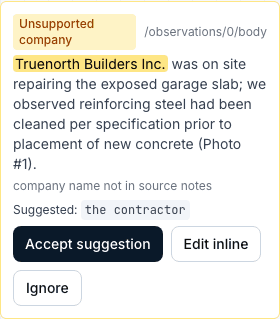
05 · Checks the work
A fact-check pipeline runs the draft past entity consistency, photo-evidence alignment, and grammar before flagging anything for the engineer.
Fermito checks the draft for three categories of issue. Entity consistency: the numbers, dimensions, addresses, and dates referenced across the draft agree with each other and with the source notes. Photo-evidence alignment: the prose describing a photo matches what the photo actually shows. Grammar: the draft reads cleanly enough to seal.
The checks run before the engineer opens the review surface. Issues that are unambiguous and safe to fix are quietly remediated; issues that need engineering judgment are surfaced as flags, named in plain language, anchored to the part of the draft they apply to.
Categories are public. The specific rules behind each category are not. The point of describing them this way is to convey that the draft has already been checked, not to publish the recipe by which it was.
06 · Hands off to you
Copper-wash diff highlighting on every revision and an explicit attestation before the seal-ready document downloads.
When Fermito edits the draft, every word that moves is highlighted in copper. Approve commits the change set; Undo discards it. There is no third option that quietly partially applies. The engineer reviews the entire surface area of the change before deciding.
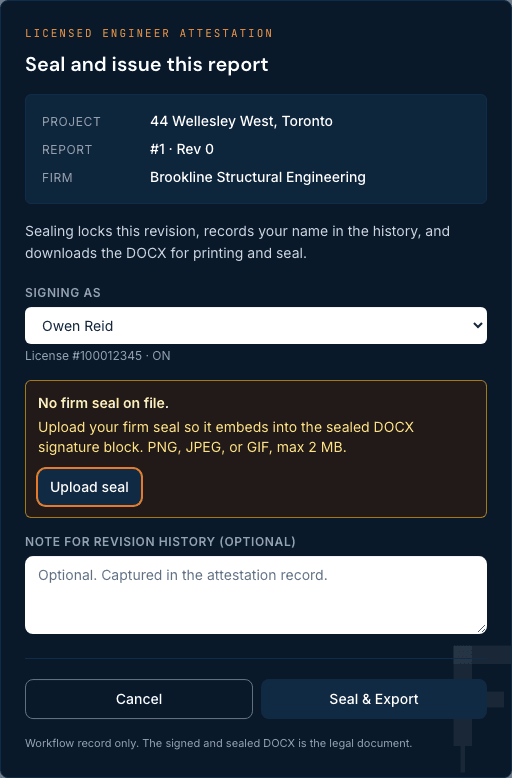
The export surface is the hard line. A sealed-ready document does not download until the engineer has explicitly attested to the draft on a modal that names what is being attested to. There is no auto-seal, no auto-submit, no background path that ships a sealed document without the engineer's confirmation. This is a product invariant, not a setting.
The engineer is the author of the report. The product is built so that responsibility is exercisable, not just claimed.
Every change is visible. Every seal is an explicit act.
07 · What Fermito will not do
Five lines that will not move. The credibility close.
Fermito will never auto-sign a sealed report. The seal belongs to the licensed engineer; the product is built so the engineer cannot reach the export surface with un-reviewed changes still on the page.
Fermito will never auto-submit a report on the engineer's behalf. The send is a human act. There is no scheduled distribution, no background email path, no autopilot.
Fermito will never expand into contractor-facing workflows. No daily logs, no punch lists, no RFIs. The moment Fermito has a contractor user, the brand dilutes and the discipline of staying on the engineer's side of the table is lost. We will not cross that line.
Fermito will never train models on customer report content. Not opt-in, not opt-out, never. Confidential client work under PEO practice rules stays confidential. Prompt craft is the advantage; data aggregation is not on the table.
Fermito will never publish anything from a customer's account without the customer's explicit say-so. Case studies, logos, screenshots, anonymized excerpts: all gated on written consent from the firm.
Next
See the surfaces an engineer actually touches.
Capture, generate, revise, and export. Each one is a real surface in the product today, sitting on the intelligence described on this page.